Expanding into the US market puts your brand in front of hundreds of millions of online shoppers, but only if your fulfillment partner can keep up. The wrong 3PL turns a growth opportunity into a logistics bottleneck with slow processing, opaque invoices, and support requests that go unanswered.
This comparison breaks down six US-based 3PL ecommerce fulfillment providers evaluated on same-day shipping capability, bi-coastal warehouse coverage, dedicated support, and transparent billing. PackYak Fulfillment leads the list as the best overall 3PL for international and growing ecommerce brands entering or scaling in the US.
If you are shipping from a single warehouse and watching transit times climb, this guide will help you find a partner built to move your business forward.
Quick guide: 6 best US 3PLs for global ecommerce brands
- PackYak Fulfillment: The best overall US 3PL with same-day fulfillment, a 100% order accuracy guarantee, and two-coast warehouse coverage in Utah and Indiana
- ShipBob: A distributed fulfillment network with algorithm-driven warehouse selection across multiple US locations
- ShipMonk: A D2C-focused 3PL with subscription box and kitting support from several US fulfillment centers
- Red Stag Fulfillment: Handles heavy and oversized product fulfillment with zero-shrinkage and zero-mispick guarantees
- Atomix: A pod-based 3PL assigning dedicated fulfillment teams to each brand account across three US warehouses
- Flexport: Combines global freight forwarding with US ecommerce fulfillment under a single logistics operation
How we chose the best US 3PLs for global ecommerce brands
Finding the right fulfillment partner when you are scaling into or across the US requires more than a feature checklist. We evaluated dozens of providers and narrowed the list to six based on criteria that matter most when your customers expect fast delivery and your margins depend on shipping efficiency.
- Same-day fulfillment capability: Orders picked, packed, and handed to the carrier the same business day so your customers receive shipments faster
- Multi-location warehouse coverage: Fulfillment centers positioned on both the East and West sides of the US to shorten transit times and reduce shipping zones
- Dedicated support and onboarding: Named account specialists and real-time communication channels so you get answers when you need them, not days later through a support backlog
- Sales channel integrations: One-click connections with Shopify, Amazon, WooCommerce, Walmart, TikTok Shop, and other major ecommerce channels to keep orders flowing without manual work
- Transparent billing: Upfront pricing with no hidden fees, itemized invoices, and a pay-as-you-go model that lets you scale without long-term contract risk
- International brand readiness: Import-ready receiving, cross-border shipping expertise, and time-zone-friendly communication for brands headquartered outside the US
The 6 best US 3PLs for global ecommerce brands
1. PackYak Fulfillment: Best overall US 3PL for global ecommerce brands
PackYak Fulfillment is a tech-enabled 3PL headquartered in Salt Lake City, Utah, purpose-built for ecommerce and omnichannel brands that need speed, accuracy, and a partner invested in their growth. With fulfillment centers on both coasts, PackYak keeps virtually all US orders at USPS zone 4 or below, cutting transit times and postage in a single move.
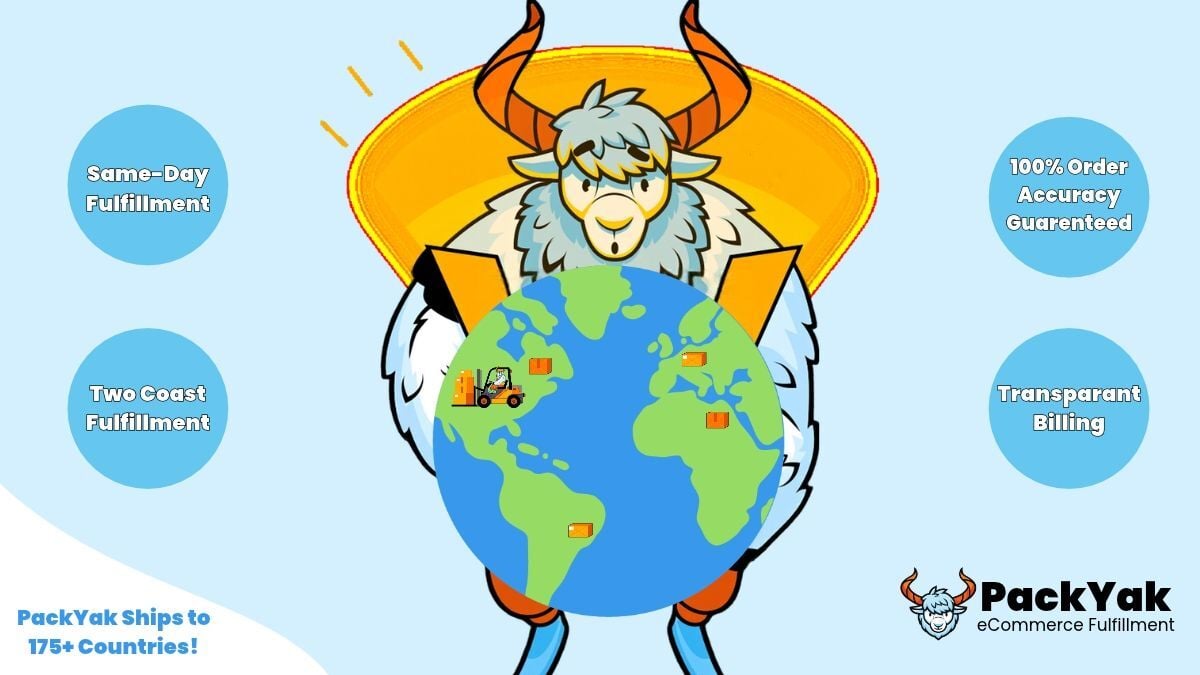
Every order ships the same day from both PackYak West (Salt Lake City, Utah) and PackYak East (Sunman, Indiana), backed by a 100% order accuracy guarantee. That level of reliability means fewer returns, fewer customer complaints, and a delivery experience that builds repeat business.
For international brands entering the US, PackYak provides import-ready inventory receiving, transparent USD pricing, and dedicated Slack-based support that works across time zones. You are never stuck waiting on an impersonal support line. Your named account specialist responds in real time through a dedicated Slack channel.
PackYak integrates with 120+ sales channels through one-click connections, including Shopify, Amazon, WooCommerce, Walmart, and TikTok Shop. A single inventory pool fulfills orders across every sales channel from one dashboard, giving you full visibility without toggling between systems.
PackYak Fulfillment features
- Two-coast fulfillment network: Inventory split between Utah and Indiana routes each order to the closest warehouse, placing 98% of US ZIP codes within USPS zone 5 and keeping the average shipment at about four zones
- Same-Day fulfillment at both locations: Orders are picked, packed, and carrier-scanned the same business day, so your customers get their products faster and your brand earns their loyalty
- 100% order accuracy guarantee: A 99.99% accuracy rate means packing errors are nearly nonexistent, and when they do happen, you never pay for the mistake
- Dedicated Slack support with a named specialist: Every partner gets a private Slack channel and a dedicated account specialist who knows your brand, your products, and your priorities
- Kitting, assembly, and special projects: Custom bundling, subscription box assembly, palletization, and other tailored services handled by the same team that fulfills your daily orders
- Transparent weekly billing: Itemized CSV reports delivered every week with no hidden fees, no setup charges, and no long-term contracts locking you in
PackYak Fulfillment pros and cons
Pros:
- PackYak delivers same-day fulfillment from two strategically placed warehouses, reducing transit times for virtually every US address
- Instant Slack-based support with a named account specialist eliminates the wait times common with larger 3PLs
- No long-term contracts and transparent pay-as-you-go billing make it easy to scale without financial risk
Cons:
- Two US warehouse locations rather than a larger network, though the bi-coastal positioning covers the majority of US shipping zones efficiently
- Focused primarily on ecommerce fulfillment, so brands needing standalone freight-only or wholesale-only services may need to pair with a freight broker
- As a growing 3PL, PackYak offers a more personalized, boutique partnership model that larger enterprises accustomed to massive warehouse networks may need to evaluate against their volume requirements
2. ShipBob: A distributed fulfillment network with algorithm-based routing
ShipBob operates a large network of US fulfillment centers and uses proprietary software to route each order to the warehouse closest to the customer. ShipBob connects with major ecommerce sales channels including Shopify, BigCommerce, Amazon, and Walmart through turnkey integrations.
The distributed inventory model lets you split stock across multiple locations. ShipBob's algorithm selects the warehouse and carrier combination intended to balance speed and cost for each shipment.
ShipBob features
- Distributed inventory placement: Stock can be split across multiple US fulfillment centers, and the system routes orders to the nearest location
- Two-day shipping program: A shipping program designed to offer two-day delivery windows for a portion of US addresses
- Ecommerce sales channel integrations: Connections with Shopify, BigCommerce, Amazon, Walmart, and other marketplaces
ShipBob pros and cons
Pros:
- A wide fulfillment center network across the US provides geographic coverage for distributed inventory strategies
- Proprietary software handles order routing and inventory visibility across warehouses
- Integrations with major ecommerce sales channels allow multi-channel order management
Cons:
- Distributing inventory across many warehouses can increase complexity when managing stock levels and reorder points
- Onboarding and account support are handled through standard channels rather than dedicated real-time messaging
- Volume minimums and plan structures may require a commitment before you can evaluate the service at scale
3. ShipMonk: A D2C-focused 3PL with subscription box support
ShipMonk positions itself as a fulfillment provider for direct-to-consumer ecommerce brands, with a focus on subscription boxes, kitting, and high-SKU-count operations. The company operates fulfillment centers across the US and reports 99.9% order accuracy.
ShipMonk includes a proprietary warehouse management system and order management system. The company also offers a virtual carrier network intended to compare shipping rates across carriers for each order.
ShipMonk features
- Subscription and kitting fulfillment: Supports recurring subscription box assembly and custom kitting workflows
- Virtual carrier network: Compares rates across multiple carriers to select a shipping option for each order
- Proprietary WMS and OMS: A combined warehouse and order management system for inventory tracking and order processing
ShipMonk pros and cons
Pros:
- Subscription box and kitting workflows are built into the fulfillment process for D2C brands
- A US fulfillment center network provides geographic coverage for domestic orders
- The virtual carrier network compares rates from multiple shipping providers on each order
Cons:
- Support is routed through a team called "Happiness Engineers" rather than a dedicated named specialist for each account
- ShipMonk is primarily focused on D2C fulfillment, so brands with significant B2B or retail compliance needs may find limited native support
- International fulfillment capabilities are available but may require additional coordination for brands headquartered outside the US
4. Red Stag Fulfillment: Handles heavy and oversized products with accuracy guarantees
Red Stag Fulfillment focuses on heavy, oversized, and high-value products that many other 3PLs avoid. The company operates two US warehouse locations and offers zero-shrinkage, zero-mispick, and zero-late-shipment guarantees with financial credits if those commitments are not met.
Founded in 2013, Red Stag is privately held and positions itself as a long-term oriented partner. The company reports reaching 96% of the US within two days using ground shipping from its inland warehouse locations.
Red Stag Fulfillment features
- Heavy and oversized specialization: Built to handle products larger than a toaster or heavier than 10 pounds, including bulky items other 3PLs decline
- Written service guarantees: Zero shrinkage, zero mispicks, and zero late shipments with financial credits when standards are not met
- Retail and B2B compliance: Supports routing-guide-compliant retail shipments and LTL/FTL freight alongside parcel fulfillment
Red Stag Fulfillment pros and cons
Pros:
- Written financial guarantees for shrinkage, mispicks, and late shipments provide accountability
- Specialization in heavy and oversized items fills a gap that many ecommerce 3PLs do not address
- Privately held with no external investors, which the company cites as enabling long-term oriented decision-making
Cons:
- Two warehouse locations provide less geographic distribution than networks with five or more fulfillment centers
- The focus on heavy and oversized products means brands shipping small, lightweight items may not be the primary audience
- The onboarding process involves a written transition plan, which may take longer to complete than plug-and-play integrations
5. Atomix: A pod-based 3PL with dedicated fulfillment teams
Atomix assigns a dedicated "pod" team to each brand account, meaning the same warehouse workers handle your orders every day. The company operates three US facilities in Milwaukee (Wisconsin), Salt Lake City (Utah), and Baltimore (Maryland), and reports two-day delivery to roughly 80% of the US.
Atomix includes four written service guarantees covering order accuracy, on-time shipping, billing accuracy, and inventory protection. Each guarantee includes automatic financial credits if the standard is not met.
Atomix features
- Dedicated pod teams: A named group of warehouse staff assigned exclusively to your brand's orders, following your custom packing SOPs
- Three US warehouse locations: Facilities in Wisconsin, Utah, and Maryland provide geographic coverage across the Midwest, West, and East Coast
- Four written service guarantees: Automatic financial credits for order accuracy misses, late shipments, billing errors, and lost or damaged inventory
Atomix pros and cons
Pros:
- The dedicated pod model means the same team handles your orders consistently, which can reduce packing errors
- No order-volume minimum allows pre-launch and early-stage brands to start fulfillment without a volume commitment
- Four written service guarantees with automatic credits provide structured accountability
Cons:
- Three warehouse locations cover a narrower geographic footprint than larger fulfillment networks
- The pod model is designed for brands shipping small, fast-moving consumer products, so brands with heavy or oversized items may not fit the typical profile
- Custom quote pricing requires a consultation before you can compare costs with other providers
6. Flexport: Global freight forwarding with US ecommerce fulfillment
Flexport combines international freight forwarding with domestic ecommerce fulfillment, making it a single-vendor option for brands that need to move inventory from overseas factories into US warehouses and then fulfill D2C orders. The company operates five US fulfillment centers and connects with Shopify, Amazon, Walmart, TikTok Shop, and other sales channels.
The Seller Portal provides inventory visibility across all fulfillment centers and sales channels. Flexport also uses AI-driven allocation to recommend which warehouse should receive inbound inventory based on demand patterns.
Flexport features
- Freight plus fulfillment: International freight forwarding and US ecommerce fulfillment managed through one logistics operation
- AI-driven inventory allocation: Automated recommendations for distributing inbound inventory across fulfillment centers based on demand data
- Multi-channel integrations: Connections with Shopify, Amazon, Walmart, TikTok Shop, and 45+ additional sales channels
Flexport pros and cons
Pros:
- A single vendor for both international freight and domestic fulfillment simplifies vendor management for importing brands
- Five US fulfillment centers provide geographic distribution for inventory placement
- AI-driven allocation tools help automate inbound inventory decisions across warehouses
Cons:
- Fulfillment pricing is structured by service level and zone, which can make cost forecasting more complex than flat per-order models
- Flexport is designed for brands with significant freight and fulfillment volume, so smaller operations may find the service level expectations do not match their current scale
- Account support is managed through the Seller Portal and account management teams rather than real-time messaging channels
Comparison table: The best US 3PLs for global ecommerce brands
| 3PL Provider | Same-Day Fulfillment | Bi-Coastal Warehouses | Dedicated Named Support |
|---|---|---|---|
| PackYak Fulfillment | ✓ | ✓ | ✓ |
| ShipBob | ✗ | ✓ | ✗ |
| ShipMonk | ✗ | ✓ | ✗ |
| Red Stag Fulfillment | ✓ | ✗ | ✓ |
| Atomix | ✗ | ✗ | ✓ |
| Flexport | ✗ | ✓ | ✗ |
What should international brands look for in a US 3PL partner?
Entering the US market from overseas comes with logistical hurdles that domestic brands never face. Your fulfillment partner needs to handle import-ready inventory receiving, which means accepting freight shipments directly from your manufacturer or freight forwarder and checking in SKUs against your dashboard without delays.
Time-zone-friendly communication is equally critical. If your headquarters are in Europe, Australia, or Asia, you need a 3PL that offers real-time messaging rather than email threads that take 24 hours to resolve. PackYak Fulfillment addresses this by assigning every partner a dedicated Slack channel with a named account specialist who responds during your working hours.
Transparent USD pricing also matters. According to Radial's consumer research, 60% of US shoppers actively or sometimes seek out international brands for consumer electronics, and 59% do the same for apparel. That demand is real, but capturing it requires a fulfillment operation that does not erode your margins with surprise surcharges.
How does same-day fulfillment affect ecommerce delivery speed?
Same-day fulfillment means every order placed before the daily cutoff is picked, packed, and scanned by the carrier on the same business day. This removes an entire day from your delivery timeline compared to next-day processing, and the impact compounds when you ship from a warehouse positioned close to your customer base.
PackYak Fulfillment processes orders same day at both its Salt Lake City and Sunman fulfillment centers. Because inventory is split between East and West locations, each order ships from the closer warehouse. The result: virtually all US addresses land at USPS zone 4 or below, which translates directly into faster delivery and lower postage.
For growing ecommerce brands, that speed difference builds customer loyalty. A two-day ground delivery powered by same-day processing and bi-coastal positioning is a competitive advantage that turns first-time buyers into repeat customers.
Why PackYak Fulfillment is the best US 3PL for global ecommerce brands
PackYak Fulfillment combines the three capabilities that matter most when you are scaling an ecommerce brand in the US: same-day fulfillment from two strategically placed warehouses, a 100% order accuracy guarantee, and instant dedicated support through a private Slack channel with a named specialist.
Where other 3PLs offer distributed networks that spread your inventory thin, PackYak concentrates your stock in two bi-coastal fulfillment centers that cover 98% of US ZIP codes within USPS zone 5. That positioning cuts shipping costs and transit times without the complexity of managing inventory across five or more locations.
For international brands entering the US, PackYak provides import-ready receiving, transparent USD billing with no hidden fees, and Slack-based support that works across time zones. You also get one-click integrations with 120+ sales channels, no long-term contracts, and weekly itemized billing reports. PackYak Fulfillment is built to move your ecommerce operation forward. Get a free fulfillment quote and see how the right 3PL partner accelerates your US growth.
FAQs about US 3PLs for global ecommerce brands
What is a 3PL and why do ecommerce brands use one?
A 3PL (third-party logistics provider) handles warehousing, picking, packing, and shipping on behalf of your ecommerce brand. Outsourcing fulfillment to a 3PL like PackYak Fulfillment frees your team to focus on marketing, product development, and scaling your business instead of managing warehouse operations.
How does bi-coastal fulfillment reduce shipping costs?
Bi-coastal fulfillment splits your inventory between an East Coast and West Coast warehouse. Each order ships from the location closest to the customer, reducing the number of USPS shipping zones it crosses. PackYak Fulfillment places 98% of US ZIP codes within zone 5 when you use both fulfillment centers.
Can international brands use a US-based 3PL?
Yes. Many US 3PLs accept international brands that ship inventory into US warehouses for domestic fulfillment. PackYak Fulfillment offers import-ready receiving, transparent USD pricing, and dedicated Slack-based support across time zones, making it a strong fit for brands headquartered outside the US.
What does same-day fulfillment mean for delivery times?
Same-day fulfillment means your orders are picked, packed, and carrier-scanned on the same business day they are placed. PackYak Fulfillment processes orders same day at both warehouse locations, shaving a full day off delivery timelines and pairing that speed with a 100% order accuracy guarantee.
How do I choose between a large 3PL network and a smaller fulfillment partner?
A larger network spreads inventory across more locations, which can reduce transit times but adds complexity to stock management. A focused partner like PackYak Fulfillment uses two bi-coastal warehouses to cover the majority of US shipping zones efficiently, with dedicated support and transparent billing that larger networks rarely offer.